Friday, August 27, 2010

The Best of All Time: 1940s, Part I

The 1940s is called the Golden Era of baseball because of the plethora of great players that graced the diamond. Many also spent time heroically serving their country as World War II broke up this decade.

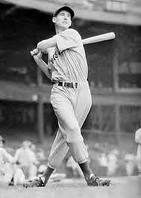
One of the best of this time period was 19-year Boston Red Sox Ted Williams. In his career, Williams batted .344 with 521 homeruns, 1,839 RBI and a .634 slugging percentage. He was an All Star 19 times and the AL MVP twice, even more remarkable because of his multiple pauses from the game when he went into active duty as a pilot in WWII and the Korean War. He was elected into the Baseball Hall of Fame in 1966.


Williams’ teammate Bobby Doerr suited up from 1937-1951. He had a .288 career average with a .461 slugging percentage. He held the Major League record for double plays as a second basemen until 1963 and his record fielding percentage of .980 lasted until 1953. He was a nine-time All Star and entered the Hall of Fame in 1986.


Yogi Berra played almost his entire 19-year career behind the plate for the New York Yankees, batting .285 with 1,430 RBI. He was on the All Star roster 18 times, helped win 13 World Series rings and was the AL MVP in 1951, 1954 and 1955. In 1972 he was inducted into Cooperstown.


Lifetime St. Louis Cardinal Stan “the Man” Musial ended his 22-year career with a .331 batting average, .559 slugging percentage and 3,630 hits, including 475 homeruns. He also had a career .989 fielding percentage. Musial was named an All Star 24 times and MVP three times. He made his way into the Hall of Fame in 1969.


On the other side of things, hurler Bob Feller spent his career in Cleveland from 1936-1956. In that time, he posted a 3.25 ERA with 2,581 strikeouts and a .621 win percentage. He was an eight-time All Star, led the league in wins six times and led the league in strikeouts seven times. He threw three no hitters, including the only Opening Day no hitter in 1938 when he struck out a then-record 18 batters. Feller became a Hall of Famer in 1962.


to be continued...

Saturday, August 21, 2010

The Best of All Time: 1930s

Mel Ott started young at just 17 years old in 1926, and went on to play 21 seasons all with the New York Giants. He finished his career with a .304 batting average and 511 homeruns. He was the first person in the National League too hit the 500 homerun mark and was also the youngest player to reach 100 homeruns. Ott was a six-time NL homerun leader, participated in twelve All Star Games and led his team in a Triple Crown category (homeruns) for 18 consecutive seasons, a feat that is yet to be broken. In 1951, he was elected into the Baseball Hall of Fame.


From the other New York team, Joe DiMaggio batted a career .325 with a .579 slugging percentage and 2,214 hits from 1936-1951 with the Yankees. He was AL MVP three times, helped the Bronx Bombers win nine World Series and he made the All Star team 13 times, making him the only player to ever be an All Star every year of his career. Most notably, DiMaggio still holds the record for consecutive games with a hit at 56. He entered the Hall of Fame in 1955.


Another slugger of the time was Jimmie Foxx. Fox played from 1925-1945 and racked up a .325 batting average, .609 slugging percentage, 534 homeruns, 1,922 RBI and a .990 fielding percentage. He was the second player to reach 500 homeruns and the second youngest to reach that feat after Alex Rodriguez. He was a nine-time All Star, three-time MVP and entered Cooperstown in 1951.


Carl Hubbell is a little more less-known to today’s fans, but his numbers warrant him mention on my list. He was a little older entering the league at 25 years old and played from 1928-1943 for the New York Giants. He finished with a 2.98 ERA, 1,677 strikeouts and a .622 win percentage. He no-hit the Pirates in 1929 and threw 18 shutout innings against the Cardinals in 1933. During the All Star Game in 1934 he did the unthinkable when he set a record for striking out five consecutive opposing All Stars; those five players: Ruth, Gehrig, Foxx, Al Simmons and Joe Cronin, all future Hall of Famers. Hubbell also won 24 consecutive games from 1936-1937, which still stands as the most consecutive wins ever. In 1943, he was chosen for the Hall of Fame.


One of the most neurotic players of all time, Dizzy Dean was also one of the best. In his career spanning from 1930-1947, he had a .302 ERA with 1,163 strikeouts. He was the last pitcher in the National League to ever have a 30-win season. He made the All Star roster four times, was the MVP in 1934 and became a Hall of Famer in 1953.


Lefty Grove was another great pitcher of the time. From 1925-1941 he had a 300-141 career record with a 3.06 ERA and struck out 2,266 batters. He was also a six-time All Star, back-to-back World Series champ in 1929 and 1930 and the 1931 AL MVP. Grove was inducted into the Hall of Fame in 1947.


Another Lefty finishes off the list of 1930s greats. Lefty Gomez spent 13 years as a Yankee from 1930-1942 and played his last season in 1943. He had a 189-102 record giving him a .649 win percentage. Gomez also had a 3.34 ERA and 1,468 career strikeouts. Seven consecutive seasons he was named an All Star from 1933-1939 and he helped earn his team five World Series rings. In the 1934 and 1937 seasons, he led the AL in wins, ERA and strikeouts. In 1972 he was elected into the Hall of Fame.

Friday, August 20, 2010

The Best of All Time: 1920s

*Note: Many of these players were successful throughout the 1930s and into the 1940s as well, but they began in the 1920s, so that is where and how I will group them.

I might as start right off the bat with the one that most people claim was the best of all time -- Babe Ruth. He started his 22-year career in 1914 but really took the spotlight after the accursed trade from the Red Sox to the Yankees in 1919. The Bambino finished with a .342 average, 2,213 RBI, 714 homeruns and an all time best .690 slugging percentage. He was a seven-time World Series champion and was named the AL MVP in 1923. In 1936, he was one of the first five members inducted into the Baseball Hall of Fame.


Right behind the Babe was another man who enters the conversation as the best player of all time. Lou Gehrig played from 1923-1939, all with the New York Yankees. The “Iron Horse” ended his career with a .340 average, .991 fielding percentage and 493 homeruns. He played in 2,130 consecutive games, even after such instances as getting a concussion after being hit in the head by a pitch. He was a seven-time All Star, owned six World Series rings, and was the league MVP in 1927 and 1936. Gehrig was an unanimous inductee into the Hal of Fame in 1939.


Another great of the 1920s was Roger Hornsby. He hit for a .358 average in 23 seasons. He is the only player to have won the NL Triple Crown twice and is also the only player to ever hit 40 homeruns and have an average above .400 in a season, which he did in 1924, batting .424. Hornsby was a two-time MVP and became a member of Cooperstown in 1942.


Red Ruffing was perhaps the best pitcher of the roaring twenties. He played from 1924-1947 with a 3.80 ERA, including 1,987 strikeouts. He also was an All Star six times, helped win six World Series titles and was elected into the Hall of Fame in 1967.


A lifetime Cincinnati Red, Edd Roush batted .323 in his career, spanning from 1913-1931. From 1917-1926, he never batted below .321 and was the NL batting champ in 1917 and 1919. Aside from his bat, his skills as an outfielder labeled him as having the best arm in the big leagues during his time. That strength was also showcased in his offense; Roush used a 48-ounce bat, the biggest in baseball. In 1962, he made his way into the Hall of Fame.

Wednesday, August 18, 2010

The Best of All Time: 1890-1920

In order to cure my blogging plague and in honor of summer coming to an end and fall ball getting underway, I am going to recap the greatest players to ever set foot on the diamond. Everyday (with the possibility of a few breaks because of my lovely work schedule) I will reminisce the best professional players of each decade, leading up to this decades’ inaugural season.

Major League Baseball began in 1869, but since the structure differed until the addition of the American League in 1901, I will start with the deadball era spanning from the 1890s to 1920.

I begin with the “Flying Dutchman” Honus Wagner. In his 21 year career, ending in 1917, he boasted a .327 batting average with a .947 fielding percentage. He won eight batting titles and led the league in slugging six times and in stolen bases five times. In 1936, he was one of five men selected in the Baseball Hall of Fame’s inaugural class.


Switching to the other side of the plate, we have Cy Young. When he retired after 22 seasons in 1911, he had a 2.63 ERA and a .618 win percentage. In 7,356 innings he struck out 2,803 batters. He is notorious for great pitching to this day since each league’s best pitcher is given an end-of-season award in his name.


One of the lesser-known greats early baseball is Nap Lajoie, who played 21 seasons from 1895-1916. He finished with a .338 batting average, although he was best known for his work in the infield, primarily as a second baseman. He had a career .967 fielding percentage and won the Triple Crown in 1901. In 1937, he was elected into Cooperstown.


Last but not least, I leave you with Ty Cobb. Cobb entered the Majors at the young age of 18 and played for 24 years before hanging up his cleats in 1928. His .367 career batting average is still the best of all-time. He also finished with a .513 slugging percentage, .961 fielding percentage and 4,191 hits. He set 90 Major League records, earned 12 batting titles (including nine in a row from 1907-1915), stole home a record 54 times, and only batted below .300 once in his astonishing career. In 1911 he was the league’s MVP and he entered the Hall of Fame with the most votes of any of the inaugural inductees with 98.2%.

Tuesday, July 27, 2010

No No No No No!... And Early Cy Young Picks

Last nights no-hitter by Matt Garza added to what is being called “The Year of the Pitcher” in the Major Leagues. Fans have been lucky enough to witness five no-hitters this season, including two perfect games – and it’s only a month after the All-Star Game, the halfway point of the season.

It all started early on in April when the Colorado Rockies were given their first no-hitter by way of 26-year-old Ubaldo Jimenez. The Dominican Republic native’s line on the night wasn’t overly impressive with 6 walks, but his 7 strikeouts helped him on his way to history. To add to the accomplishment, he also had a RBI and scored a run in the game. Jimenez has only continued to cruise since his no-no. He was rightfully named the NL All-Star Game starter and now holds the most wins in the Majors with a 15-2 record and 2.75 ERA.

A few weeks later, it was a 26-year-old AL pitcher’s turn. Oakland’s Dallas Braden achieved perfection against the Rays with 109 pitches, including six strikeouts, in the 19th perfect game in MLB history. Out of the five so far this season, Braden’s perhaps was the most emotional and inspiring. Braden grew up an hour away from Oakland and had a rough childhood being the son of a single mom. When he was a senior in high school his mother passed away from cancer. His grandmother was there to watch Braden’s every perfect pitch and was the first to give him a congratulatory hug. The biggest significance of the day? It was on Mother’s Day.

Twenty days later, Phillies’ veteran Roy Halladay obtained a perfect game of his own in a 1-0 win against the Marlins. The 159-84 career ace needed 115 pitches to complete the feat, which included a personal and Phillies season high 11 strikeouts. Halladay’s numbers have continued to impress this season as he is tied for 3rd in the NL with 11 wins, is 4th in the Majors with a 2.28 ERA and is tied for a 4th in the NL with 140 Ks.

Diamondbacks starter Edwin Jackson was probably the most improbable to get a no-no this season. On June 26, his pitch count topped 60 pitches by the 3rd inning, but he told his manager, “I’m not coming out until I give up a homerun or a hit.” Good thing his manager listened. In the end, Jackson finished with 149 pitches and 8 walks in the game, but the zero in the second column on the scoreboard was all that mattered as he led the Dbacks in the 1-0 win against the Rays.

After being no-hit twice already this season, Tampa Bay got redemption of its own through Matt Garza’s gem last night. His no-hitter was the first in the young franchise’s history. He gave up just one walk in the 7th inning, but still managed to face the minimum as his walk was followed by an inning-ending double play. It took him 120 pitches to get his 27 outs.

With all the great pitching performances this season, even beyond the five no-hitters, it’s hard not to start thinking about who will get the Cy Young this season. If the season continues on the way it has thus far, I think it is pretty clear that the NL will award it to Jimenez. With his no-hitter, All-Star start, MLB-leading 15 wins and miniscule 2.75 ERA, there are very few others that can compete.

The AL, however leaves a lot more options. Ironically, at this point I have to go with the other All-Star starter, David Price of the Tampa Bay Rays. The top pick from 2007 leads the AL with 13 wins and is 5th with a 2.90 ERA. Another possibility in the Cy Young race who has been doing things more quietly is veteran ace Andy Pettitte. He holds a 11-2 record with a 2.88 ERA for the AL East-leading Yankees.

But, as everyone knows, with 60-some games left in the regular season, anything is bound to happen. Let’s hope it continues to be as exciting as it’s been thus far.